

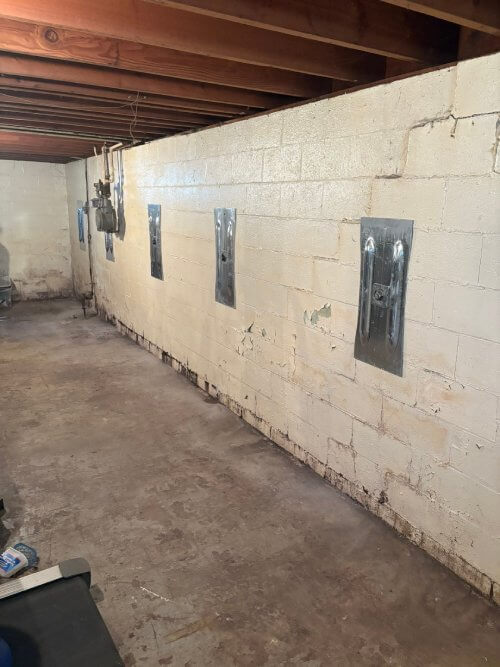
Fall is the last real window to catch foundation problems before Iowa’s freeze-thaw cycle gets to work on them. Once the ground freezes, soil expands, contracts, and shifts against your foundation walls all winter. A small problem you could fix in October turns into a bigger, more expensive one by March.
We’ve walked through thousands of Eastern Iowa basements, and the story is usually the same. A homeowner notices something small, waits a season or two, and calls us once a crack has gone from hairline to finger-width. Here are the five foundation repair signs worth acting on now.
The 5 Foundation Repair Signs to Watch For
1. Cracks in Basement Walls, Especially Stair-Step Patterns
Not every crack means trouble. Thin vertical cracks in poured concrete are often just normal curing and shrinkage. What concerns us are horizontal cracks and stair-step cracks that follow the mortar joints in a block foundation.
A stair-step crack usually means the soil outside your foundation is pushing against the wall unevenly. Horizontal cracks are a bigger red flag, often showing up when a wall bows inward under pressure from saturated clay soil, which is common across Eastern Iowa. If you can fit a coin into the crack, or if it’s grown since you last checked, have it looked at before winter moisture makes it worse.
2. Bowing or Leaning Basement Walls
Run a level or a straight board against your basement wall. If it’s not flush, or you can see a visible inward curve, the wall is moving. This usually happens gradually, so homeowners who’ve lived in the same house for years sometimes miss it because the change happens slowly enough to feel normal.
Bowing walls need a structural fix, not a patch. We install Grip-Tite wall anchors and steel I-beams to stop the movement and, in many cases, straighten the wall back out over time with simple adjustments the homeowner can make using a torque wrench we provide. Left alone, a bowing wall keeps moving.
3. Doors and Windows That Stick or Won’t Latch
If your interior doors have started sticking, dragging on the floor, or popping open on their own, don’t blame it on humidity first. Foundation settling changes the shape of your house’s frame just enough to throw door and window frames out of square. The same goes for windows that are suddenly hard to open or draftier than they used to be.
This sign is easy to write off because it seems minor. But sticking doors are often the first visible clue that a foundation has started to settle unevenly, so it’s worth checking before assuming it’s just an old house acting up.
4. Uneven or Sloping Floors
Set a marble on your floor. If it rolls toward one side of the room, or you’ve noticed a soft, bouncy spot when walking across it, the foundation is likely settling unevenly. This happens when part of the foundation loses support from the soil beneath it, whether from erosion, poor original compaction, or years of moisture cycling through the ground.
Uneven floors get worse gradually, then noticeably worse after a wet spring or a hard freeze-thaw winter. Iowa’s loess and clay-heavy soils are especially prone to this kind of movement, which is why we see it so often in older neighborhoods across Cedar Rapids, Iowa City, and Cedar Falls.
5. Water Intrusion or Musty Odors in the Basement
Foundation problems and water problems usually travel together. A crack that lets in water after a heavy rain, a musty smell that wasn’t there last year, or visible dampness along the base of your walls all point to water finding a path through or around your foundation.
This matters even more heading into winter. Water that seeps in and freezes inside a crack expands and makes the crack bigger. If you’re seeing water intrusion now, get it addressed before the freeze-thaw cycle turns a small leak into a structural problem.
Why Iowa’s Climate and Soil Make This Worse Every Winter
Eastern Iowa sits on a mix of loess and clay-heavy soils that expand when wet and contract when dry. Add a deep frost line and a freeze-thaw cycle that repeats for months, and you’ve got soil constantly pushing and pulling against your foundation walls. That repeated movement is also what turns early foundation repair signs into serious structural problems if they’re left unaddressed heading into winter.
Older homes in established neighborhoods, whether a craftsman near downtown Cedar Rapids or a mid-century home in Iowa City, tend to feel this the most, since they were often built before modern drainage and waterproofing standards existed. The foundation repair signs we see most often in these homes, stair-step cracks, bowing walls, and persistent water intrusion, are a direct result of decades of freeze-thaw pressure on foundations that were never designed to handle it. Newer homes aren’t immune either. Poor grading, clogged gutters, and downspouts that dump water too close to the foundation all speed up the same problems.
Once the ground freezes solid, most foundation repair systems can’t be installed properly, and signs you notice in October only get worse in the meantime. That’s why fall is the season we get the most calls, and why waiting until spring almost always costs more.
Foundation Repair Signs: Homeowner Symptoms and What They Usually Mean
Once you know what to look for, deciding what to do next comes down to matching what you’re seeing to what’s actually happening underground. Here’s a quick reference for the symptoms covered above.
| What You’re Noticing | What It Usually Means | What to Do |
|---|---|---|
| Thin, vertical crack in a poured wall | Normal concrete curing and shrinkage | Monitor it. Note the length and width so you can track any change. |
| Horizontal crack in a basement wall | Wall bowing inward under soil pressure | Get a professional inspection soon. This is a structural warning sign, not cosmetic. |
| Stair-step crack in a block wall | Uneven soil pressure pushing against the foundation | Schedule an inspection. Left alone, it typically widens over time. |
| Visible inward curve or bowing wall | Active wall movement from hydrostatic or soil pressure | Call for an inspection now. Wall anchors or Carbon Guard straps are most effective before the bow worsens. |
| Doors or windows sticking or popping open | Foundation settling has thrown the frame out of square | Rule out humidity first, but if it persists across seasons, have the foundation checked. |
| Sloping or bouncy floors | Uneven settling from lost soil support beneath the foundation | Schedule an inspection, especially if the slope has gotten more noticeable recently. |
| Water intrusion or musty basement smell | Water finding a path through or around the foundation | Address it before winter. Freezing water inside a crack makes it worse. |
| Multiple signs appearing together | Foundation movement is likely active and progressing | Call for an inspection as soon as you can. Combined symptoms usually mean it’s past the monitor-and-wait stage. |
When to Call a Professional
A few small cracks or a door that sticks once in a while doesn’t necessarily mean you need a major repair. But you should call a professional if you notice any of the following:
- A crack that’s grown wider or longer since you first noticed it
- Any horizontal or stair-step cracking
- Visible bowing when you check a wall with a level
- Multiple signs showing up at once, like sticking doors and sloping floors together
- Water actively coming through a wall or floor crack
At Tomlinson Cannon, we offer free foundation inspections, and we’ll tell you honestly if your foundation doesn’t need repair yet. If it does, we’ll walk you through exactly what’s happening and what your options are, using proven Grip-Tite systems we’ve trusted since 1948.
We serve homeowners across Cedar Rapids, Iowa City, and Cedar Falls, and we’ve seen how each of these communities deals with its own version of the same soil and climate challenges. Our crews know the local building styles, the local soil, and how to fix the problem for good rather than patch it for now.
Frequently Asked Questions
How much does foundation repair cost in Iowa?
Cost depends on which repair method your home needs. Crack sealing and epoxy injection are the least expensive fix, wall anchors and Carbon Guard straps cost more because they address structural movement, and push piers or helical piers cost the most since they involve lifting and stabilizing the entire foundation. A free inspection is the only way to get an accurate number for your specific situation.
Can I wait until spring to fix a foundation crack?
We don’t recommend it. Water that gets into a crack and freezes over winter expands and can turn a hairline crack into a structural one. Addressing it in fall or early winter, before the ground fully freezes, usually costs less and prevents further damage. It’s also harder to install most foundation repair systems once the ground has frozen solid.
Do all foundation cracks need professional repair?
No. Small, thin vertical cracks from normal concrete curing are usually cosmetic. Horizontal cracks, stair-step cracks, or any crack that’s actively growing or leaking water are the ones that need a professional look.
What causes foundation problems in Eastern Iowa specifically?
A combination of clay-heavy and loose soils that expand and contract with moisture, plus a deep frost line and repeated freeze-thaw cycles each winter. Poor drainage and clogged gutters around the home make the problem worse.
What’s the difference between wall anchors and push piers?
Wall anchors address bowing or leaning basement walls. We install high-strength rods through the wall, anchored deep underground, which stop the inward movement and can gradually straighten the wall over time using simple adjustments the homeowner makes with a torque wrench we provide. Push piers address a different problem: a foundation that’s sinking or settling. Steel piers are driven deep into stable, load-bearing soil to lift and permanently support the structure. A free inspection will tell you which one, if either, your home needs.
Will foundation repair actually straighten a bowing wall, or just stop it from getting worse?
Both, in most cases. Wall anchor systems stop the wall from moving further, and many homeowners can gradually straighten the wall back toward its original position over months by making small adjustments with a torque wrench. For walls that are severely bowed, we may recommend steel I-beams or Carbon Guard carbon fiber straps instead, which stabilize the wall without requiring exterior excavation.
Does foundation repair come with a warranty?
Yes. Our structural foundation repairs come with a lifetime guarantee that the repair will stabilize your foundation and walls where installed. That guarantee is transferable once, so if you sell your home, the next owner gets the same protection.
Will foundation repair affect my home’s resale value?
It usually protects it. Unaddressed foundation problems are one of the first things a home inspector flags during a sale, and they can scare off buyers or trigger a price renegotiation. A repair backed by a transferable lifetime guarantee reassures buyers that the issue has been permanently resolved, not just patched.
Can foundation problems come back after they’re repaired?
Properly installed systems like Grip-Tite wall anchors and push piers are designed to be permanent, which is why they carry a lifetime guarantee. Problems are more likely to resurface if the underlying water issue, like poor grading or a clogged gutter system dumping water next to the foundation, isn’t also addressed. That’s why we often pair foundation repair with waterproofing or drainage corrections.
Do I need an inspection even if I’m not sure it’s a foundation issue?
Yes. Sticking doors, musty basement smells, and small cracks all have other possible causes, but they’re also the earliest signs of foundation movement. A free inspection tells you definitively whether you’re looking at a foundation problem or something unrelated, without any pressure to act if the answer is the latter.
Don’t Wait for Winter to Make the Decision for You
Every fall, we get calls from homeowners who noticed a crack in August and figured it could wait. By the time the ground freezes, that same crack has usually widened, and the repair options have narrowed along with the timeline. If you matched anything in the table above to your own home, the smarter move is getting eyes on it now, while a wall anchor or a bead of epoxy can still solve the problem instead of a full pier system.
Not sure yet whether what you’re seeing is serious? Our foundation repair page walks through how we diagnose and fix each type of issue. Want to hear it from someone who’s been through it? Our testimonials page has real homeowners describing what we found and how we fixed it.
Want to know where your foundation actually stands? Give us a call at (319) 337-2225. We’ll send someone out for a free, no-pressure inspection and get you an honest answer before winter makes the decision harder.
By Justin Anderson, Sales Representative at Tomlinson Cannon
Justin has spent 10 years working directly with homeowners to diagnose foundation and basement issues across Eastern Iowa. He stays involved from the initial assessment through the completion of every project, so he sees firsthand which small foundation problems turn into expensive ones once winter sets in.