

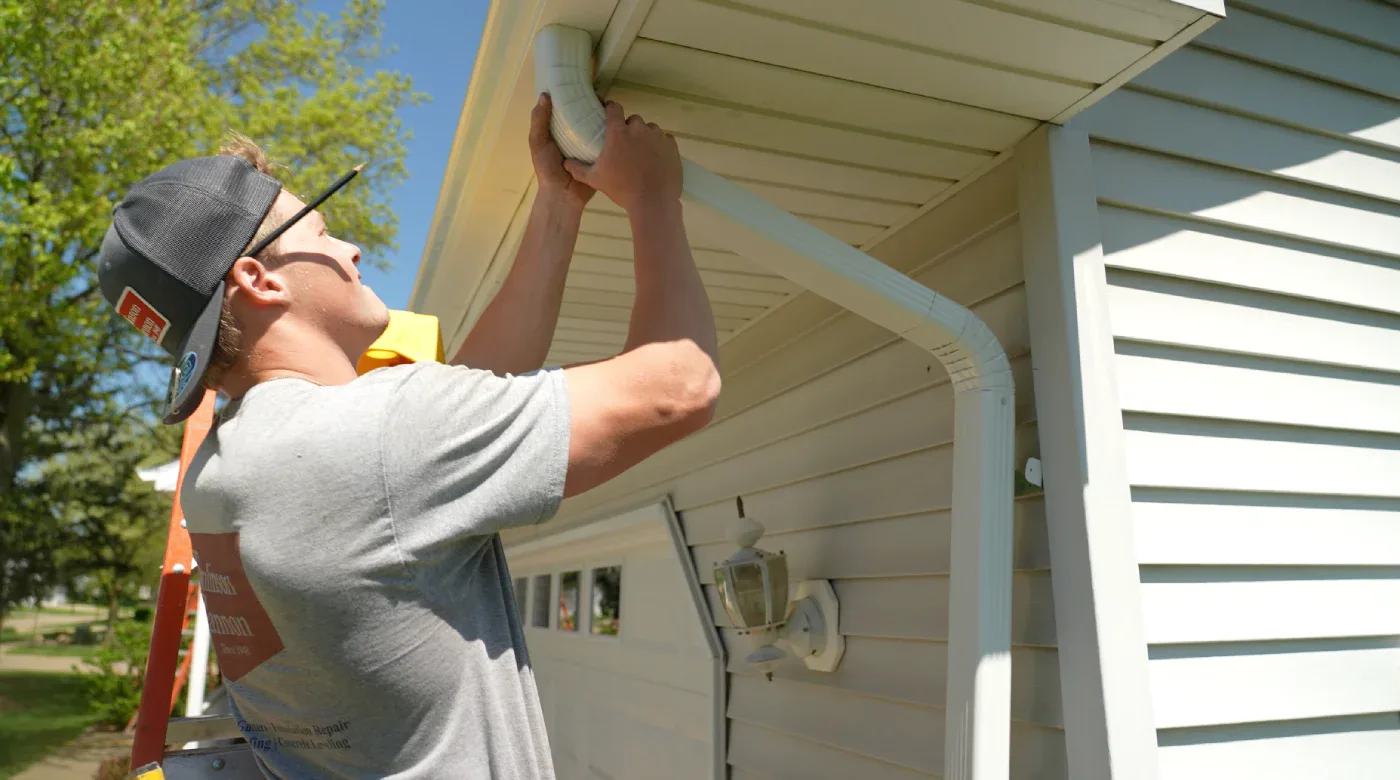
The short answer: 5-inch gutters handle most standard roofs in Iowa City and Cedar Rapids just fine, while 6-inch gutters make more sense on larger roofs, steeper pitches, or homes that have dealt with overflow during heavy rain. The right size depends on how much water your roof sheds and how fast it needs to move.
What Actually Changes Between 5-Inch and 6-Inch
The number refers to the width of the gutter’s top opening, which determines how much water it can carry before it overflows.
5-inch gutters are the standard size for most residential homes. They pair with a 3-inch downspout and handle the water volume off a typical single-story or moderately pitched roof without issue. They’re also the more common size, so replacement parts and matching components tend to be easier to source down the road.
6-inch gutters carry roughly 40% more water than a 5-inch system, largely because they’re usually installed with a 3×4-inch downspout that moves water out faster, not just more of it. That extra capacity matters most on larger roofs, steep pitches that speed up runoff, or homes with long, unbroken roof runs that funnel a lot of water to one section of gutter.
Both sizes come in the aluminum materials, colors, and styles Tomlinson Cannon installs, and both carry the same lifetime guarantee on paint and leaks. Choosing 6-inch isn’t an upgrade in durability, it’s a capacity decision based on your specific roof.
The Symptoms That Mean Your Gutters Are Too Small
Most homeowners don’t start out asking “5-inch or 6-inch.” They start out with a problem, and the size question comes later. If any of this sounds familiar, undersized gutters could be the reason:
- Water sheets over the front edge of the gutter during a hard rain instead of draining through the downspout
- You see staining or streaking on the siding below the gutter line
- Mulch or landscaping near the downspout gets pushed around after storms
- The gutters look full or sag even right after cleaning
- Ice builds up along the roofline in winter faster than it used to
None of these automatically mean you need a bigger gutter. Clogged downspouts, incorrect pitch, and loose hangers cause the same symptoms and are a simpler fix. But if your gutters are properly pitched, clean, and still overflowing, size is worth a look.
Why This Question Comes Up More in Iowa
Roof size and pitch are only half of it. Iowa’s weather adds pressure that homeowners in drier climates don’t deal with.
Eastern Iowa gets somewhere in the range of 36 to 40 inches of precipitation a year, according to NOAA climate normals compiled by the National Centers for Environmental Information, with June typically the wettest month. That’s not unusually high compared to the rest of the country, but a lot of it arrives in short, intense summer storms rather than spread evenly across the year. A gutter system that’s marginally sized can handle a light, steady rain and still overflow during a 2-inch downpour in twenty minutes.
Winter adds a second factor. Snow melts off the roof during the day and refreezes overnight, and a gutter that’s already running near capacity is more prone to ice damming when meltwater backs up instead of draining. This is less about gutter width specifically and more about the whole system, pitch, hangers, and downspout placement, working together so water actually leaves the roofline instead of sitting in it.
None of this means every Iowa home needs 6-inch gutters. It means the decision should be based on your actual roof, not a general rule of thumb.
How to Decide Which Size Is Right for Your Home
A few questions help narrow it down before you even call a contractor:
How big is your roof? A small ranch home usually does fine with 5-inch gutters. A two-story home with a large roof surface, especially one with multiple rooflines draining into the same gutter run, is a more likely candidate for 6-inch.
How steep is the pitch? Steeper roofs shed water faster, which means more volume hits the gutter in less time. Steep-pitched homes often benefit from the extra capacity even if the roof itself isn’t unusually large.
Have you had overflow problems before? If your current gutters overflow during heavy rain and they’re clean, properly pitched, and not damaged, that’s a real signal your existing size may be undersized for the roof.
What does your roofline actually look like? Homes with long, continuous gutter runs and few breaks concentrate more water at fewer downspouts, which pushes toward 6-inch even on a moderately sized roof.
When to Call a Professional Instead of Guessing
Gutter sizing looks straightforward on paper, but it depends on roof square footage, pitch, valleys, and how many downspouts you’re working with, and getting it wrong in either direction costs money. Oversizing wastes material. Undersizing means overflow and the water damage that comes with it.
This is worth a professional assessment rather than a guess, especially if you’re already dealing with overflow, ice damming, or siding stains. A contractor familiar with Iowa roofs can walk your specific home, measure the roof area feeding each downspout, and tell you whether 5-inch covers it or whether you’d be better served by 6-inch.
Frequently Asked Questions
Do 6-inch gutters cost more than 5-inch? Generally yes, since they use more material and a larger downspout, though the difference varies by home and installer. Ask for a quote based on your specific roof rather than assuming a flat difference.
Can I mix gutter sizes on the same house? In some cases, yes. A home with one section of roof that drains a lot more water than the rest can use 6-inch on that run and 5-inch elsewhere. This is a call best made during an on-site assessment.
Will 6-inch gutters fix an ice dam problem? Not on their own. Ice dams usually involve attic insulation and ventilation as much as gutter capacity. Bigger gutters can help move meltwater faster, but they’re rarely the whole fix.
How do I know if my current gutters are actually undersized, versus just clogged or poorly pitched? Clean them out and check the pitch first. If they still overflow during moderate rain after that, size is a more likely culprit.
Get a Straight Answer for Your Home
If you’re weighing 5-inch against 6-inch and aren’t sure which one fits, Tomlinson Cannon can walk your roof and give you a recommendation based on the actual square footage, pitch, and drainage pattern of your home, not a generic rule. Call us at (319) 337-2225 or request a free quote online and we’ll help you land on the right size the first time.
By Cole Flatland, Cedar Rapids Gutters Manager, Tomlinson Cannon Cole leads the Cedar Rapids gutters team at Tomlinson Cannon, where he oversees seamless gutter installations across Cedar Rapids and the surrounding area.